ABCA12-nEDD
Previously: Harlequin ichthyosis, ARCI, CIE, Erythrokeratodermia variabilis et progressiva
Key Clinical Clues
Phenotype can vary from mild to very severe, including at birth- truncal fissured plate-like scales, severe ectropion and eclabium, resolving to severe scaly erythroderma. Milder phenotypes can present as collodion or scaly erythroderma.
Additional Cutaneous Features
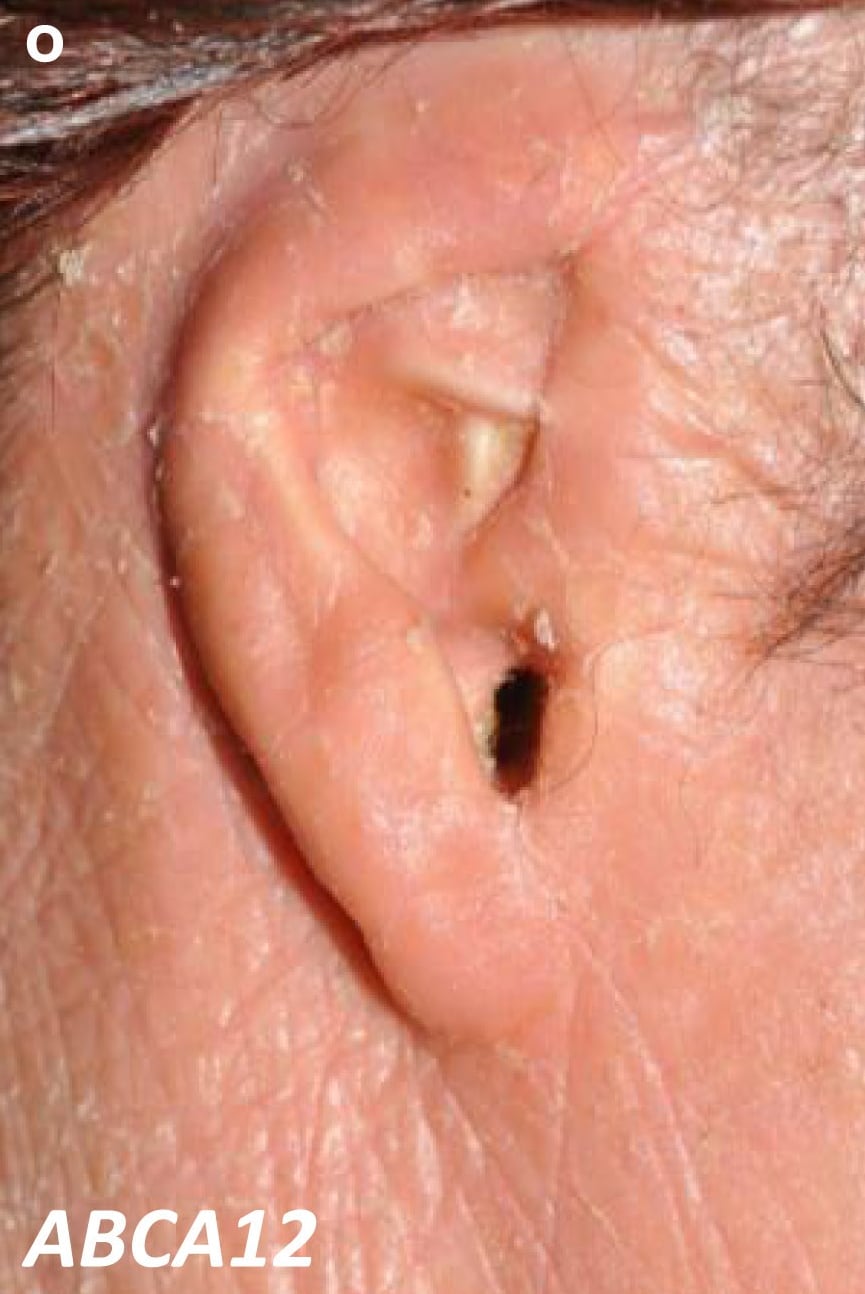
Shortening and webbing of the digits. Mild-to-severe ear deformities, hypercurvature of the nail plate and alopecia can be present. Some cases show a GJB3-nEDD-like phenotype (well-demarcated, thickened, erythematous plaques). Histopathology (Ultrastructural): malformed lamellar granules and lipid vacuoles in granular layer and corneocytes.
Additional Extracutaneous Features
Severe cases (formerly Harlequin) show deformed nose, ears, hands, feet, and joint contractures.
References
Kelsell DP, Norgett EE, Unsworth H et al. Mutations in ABCA12 underlie the severe congenital skin disease harlequin ichthyosis. Am J Hum Genet 2005; 76:794-803. || Akiyama M, Sugiyama-Nakagiri Y, Sakai K et al. Mutations in lipid transporter ABCA12 in harlequin ichthyosis and functional recovery by corrective gene transfer. J Clin Invest 2005; 115:1777-84. || Lefévre C, Audebert S, Jobard F et al. Mutations in the transporter ABCA12 are associated with lamellar ichthyosis type 2. Hum Mol Genet 2003; 12:2369-78. || Hotz A, Fölster-Holst R, Oji V et al. Erythrokeratodermia variabilis-like phenotype in patients carrying ABCA12 mutations. Genes (Basel) 2024; 15:288. || Noda T, Takeichi T, Tanahashi K et al. Updated mutational spectrum and genotype-phenotype correlations in ichthyosis patients with ABCA12 pathogenic variants. Exp Dermatol 2024; 33:e15072.
Summarised from published literature for general information. This is not medical advice, and entries are still being verified. Read the full disclaimer
Clinical Trial Opportunities
This feature is coming soon.