DSP-sEDD-cardiomyopathy
Previously: Erythrokeratodermia-cardiomyopathy syndrome (EKC); Carvajal syndrome
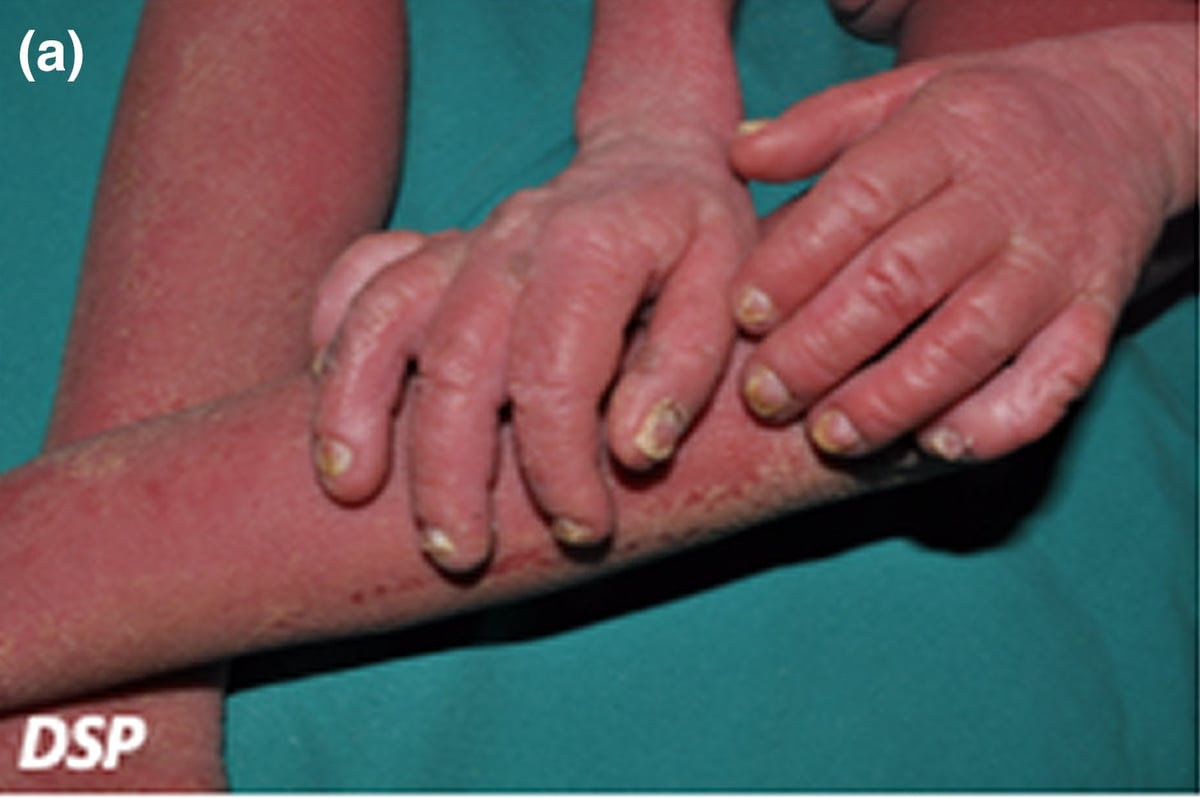
Key Clinical Clues
Generalized erythema with skin thickening; striate PPK; woolly, sparse-to-absent hair.
Additional Cutaneous Features
Generalized erythema with skin thickening and fine white scaling; PPK may be striate with variable blistering; keratoses on knees/elbows; pruritus; pustular flares; woolly, sparse-to-absent hair, nail dystrophy.
Additional Extracutaneous Features
Cardiomyopathy/arrhythmias; dental enamel anomalies; failure to thrive; developmental delay; occasional corneal opacities.
Treatment
SC injection of biologics targeting IL-12/IL-23 (has reversed cardiomyopathy) (Paller, 2018; Sun, 2021).
References
Boyden LM, Kam CY, Hernández-Martin A et al. Dominant de novo DSP mutations cause erythrokeratodermia-cardiomyopathy syndrome. Hum Mol Genet 2016; 25:348-57. || Carvajal-Huerta L. Epidermolytic palmoplantar keratoderma with woolly hair and dilated cardiomyopathy. J Am Acad Dermatol 1998; 39:418-21. || Polivka L, Bodemer C, Hadj-Rabia S. Combination of palmoplantar keratoderma and hair shaft anomalies, the warning signal of severe arrhythmogenic cardiomyopathy: a systematic review on genetic desmosomal diseases. J Med Genet 2016; 53:289-95. || Sun Q, Wine Lee L, Hall EK et al. Hair and skin predict cardiomyopathies: Carvajal and erythrokeratodermia cardiomyopathy syndromes. Pediatr Dermatol 2021; 38:31-8.
Summarised from published literature for general information. This is not medical advice, and entries are still being verified. Read the full disclaimer
Clinical Trial Opportunities
This feature is coming soon.