EBP-sEDD
Previously: Chondrodysplasia punctata, X-linked dominant (CDPX2); Conradi-Hünermann-Happle syndrome
Key Clinical Clues
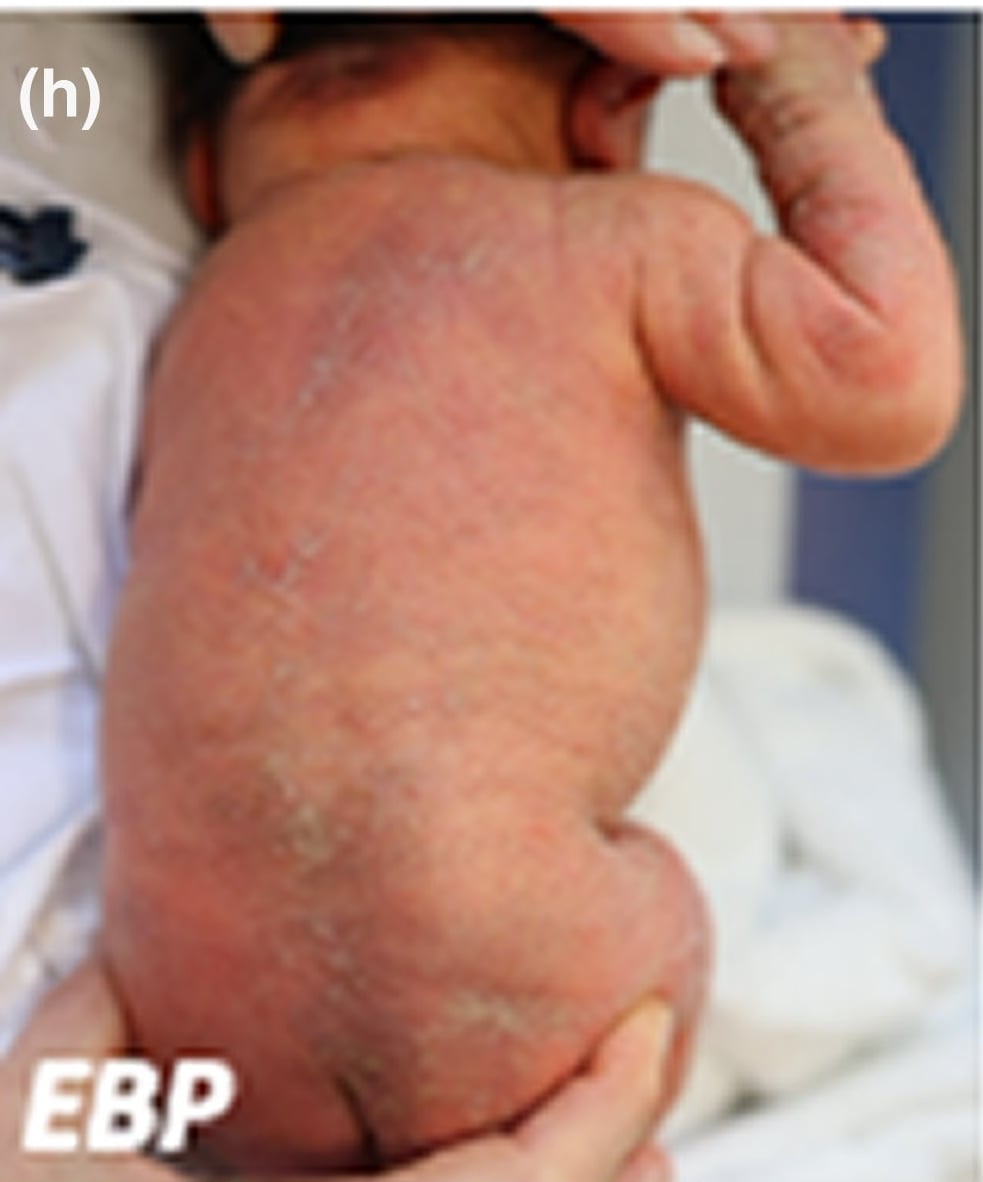
Congenital generalized scaling and erythroderma; evolves to blaschoid pattern with follicular atrophoderma.
Additional Cutaneous Features
Partial collodion membrane or generalized scaly erythroderma. Spontaneous improvement during first month, leaving linear and whorled patterns of scale, erythroderma, follicular atrophoderma along lines of Blaschko; variable PPK and nail dystrophy, cicatricial alopecia also along lines of Blaschko.
Additional Extracutaneous Features
Punctiform calcification of the bones (especially early in life); often shortened proximal bones, saddle nose deformity and other bone abnormalities, including short stature; cataracts and corneal opacity.
Treatment
Possibly effective: Topical combination of statin and cholesterol (based on Paller, 2011).
References
Pacault M, Vincent M, Besnard T et al. New splicing pathogenic variant in EBP causing extreme familial variability of Conradi-Hünermann-Happle Syndrome. Eur J Hum Genet 2018; 26:1784-90. || Sutphen R, Amar MJ, Kousseff BG, Toomey KE. XXY male with X-linked dominant chondrodysplasia punctata (Happle syndrome). Am J Med Genet 1995; 57:489-92. || Horinouchi T, Morisada N, Uemura H et al. Male CDPX2 patient with EBP mosaicism and asymmetrically lateralized skin lesions with strict midline demarcation. Am J Med Genet A 2019; 179:1315-18. || Furtado LV, Bayrak-Toydemir P, Hulinsky B et al. A novel X-linked multiple congenital anomaly syndrome associated with an EBP mutation. Am J Med Genet A 2010 152A:2838-44. || Cañueto J, Girós M, Ciria S et al. Clinical, molecular and biochemical characterization of nine Spanish families with Conradi-Hünermann-Happle syndrome: new insights into X-linked dominant chondrodysplasia punctata with a comprehensive review of the literature. Br J Dermatol 2012; 166:830-8.
Summarised from published literature for general information. This is not medical advice, and entries are still being verified. Read the full disclaimer
Clinical Trial Opportunities
This feature is coming soon.