KRT-nEDD-mosaic
Previously: Epidermolytic naevus
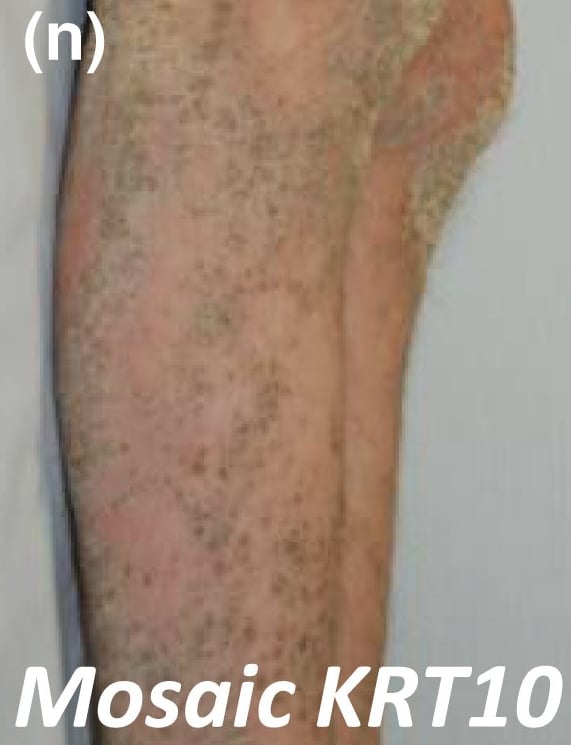
Key Clinical Clues
Localized skin thickening, scaling and erosions following the lines of Blaschko.
Additional Cutaneous Features
Histopathology (KRT1, KRT10, KRT16): Granular degeneration, perinuclear vacuoles, sometimes epidermolysis. Histopathology (KRT2): Granular degeneration and sometimes epidermolysis in superficial epidermis. Rare binuclear keratinocytes.
Treatment
Small molecules, siRNA, repurposed drugs.
References
Tsubota A, Akiyama M, Sakai K et al. Keratin 1 gene mutation detected in epidermal nevus with epidermolytic hyperkeratosis. J Invest Dermatol 2007; 127:1371-4. || Diociaiuti A, Castiglia D, Corbeddu M et al. First case of KRT2 epidermolytic nevus and novel clinical and genetic findings in 26 Italian patients with keratinopathic ichthyoses. Int J Mol Sci 2020; 21:7707. || Samuelov L. Sarig O, Gat A et al. Extensive lentigo simplex, linear epidermolytic naevus and epidermolytic naevus comedonicus caused by a somatic mutation in KRT10. Br J Dermatol 2015; 173:293-6. || Terrinoni A, De Laurenzi V, Candi E et al. A mutation in the V1 domain of K16 is responsible for unilateral palmoplantar verrucous nevus. J Invest Dermatol 2000; 114:1136-40.
Summarised from published literature for general information. This is not medical advice, and entries are still being verified. Read the full disclaimer
Clinical Trial Opportunities
This feature is coming soon.