NSDHL-sEDD-CHILD
Previously: Congenital hemidysplasia-ichthyosiform naevus-limb defect (CHILD) syndrome
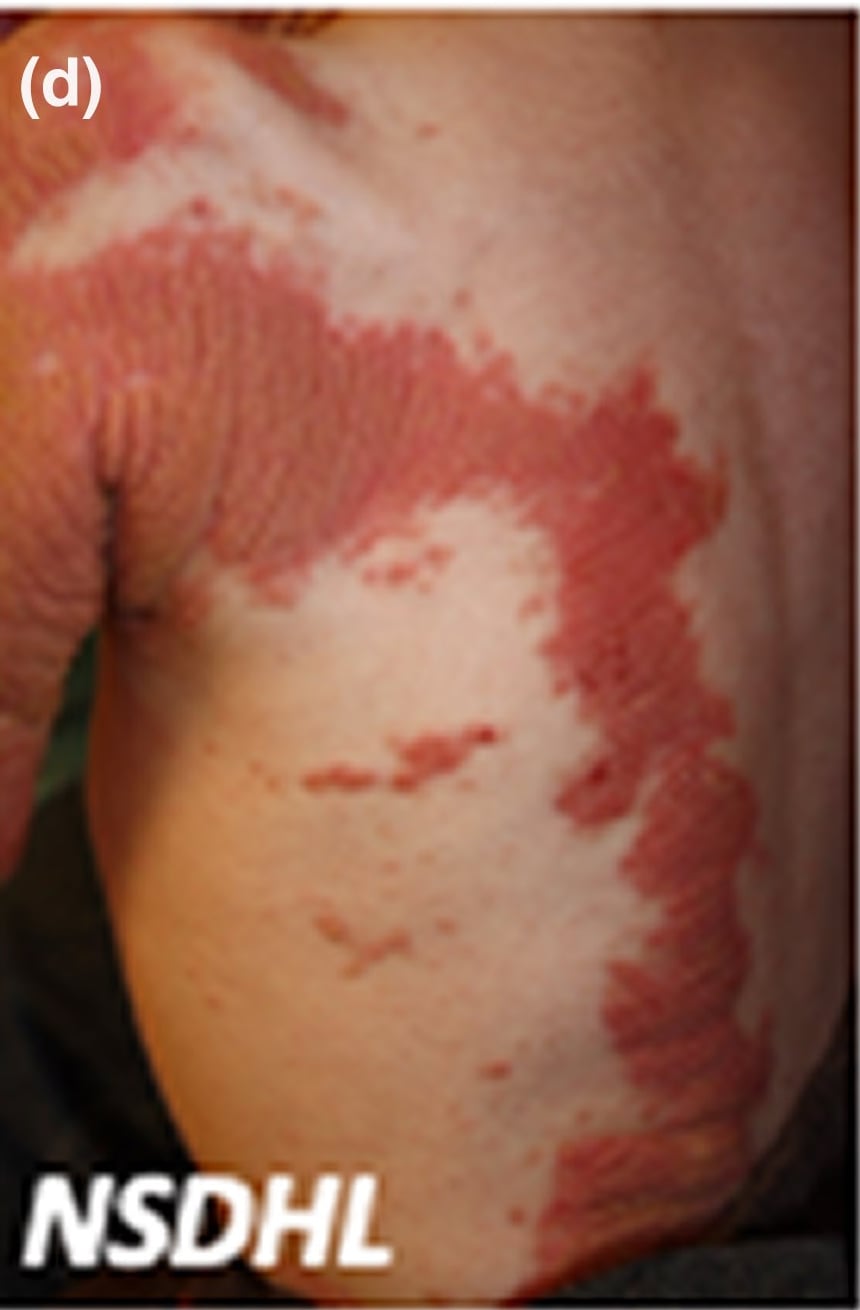
Key Clinical Clues
Unilateral patterned skin erythema/thickening and limb deformities.
Additional Cutaneous Features
Unique lateralization pattern of well-demarcated blaschkoid-to-broad bands of erythematous scaling plaques; variable extent; onychorrhexis if digital involvement.
Additional Extracutaneous Features
Prominent bone defects (shortened proximal bones); other congenital anomalies: cardiovascular, urogenital, neurological and ipsilateral thyroid or adrenal gland hypoplasia.
Treatment
Topical combination of statin and cholesterol (Paller, 2011).
References
König A, Happle R, Bornholdt D et al. Mutations in the NSDHL gene, encoding a 3beta-hydroxysteroid dehydrogenase, cause CHILD syndrome. Am J Med Genet 2000; 90:339-46. || Traupe H, Has C. The Conradi-Hünermann-Happle syndrome is caused by mutations in the gene that encodes a 8-7 sterol isomerase and is biochemically related to the CHILD syndrome. Eur J Dermatol 2000; 10:425-8. || Bornholdt D, König A, Happle R et al. Mutational spectrum of NSDHL in CHILD syndrome. J Med Genet 2005; 42:e17.
Summarised from published literature for general information. This is not medical advice, and entries are still being verified. Read the full disclaimer
Clinical Trial Opportunities
This feature is coming soon.