STS-sEDD
Previously: X-linked ichthyosis
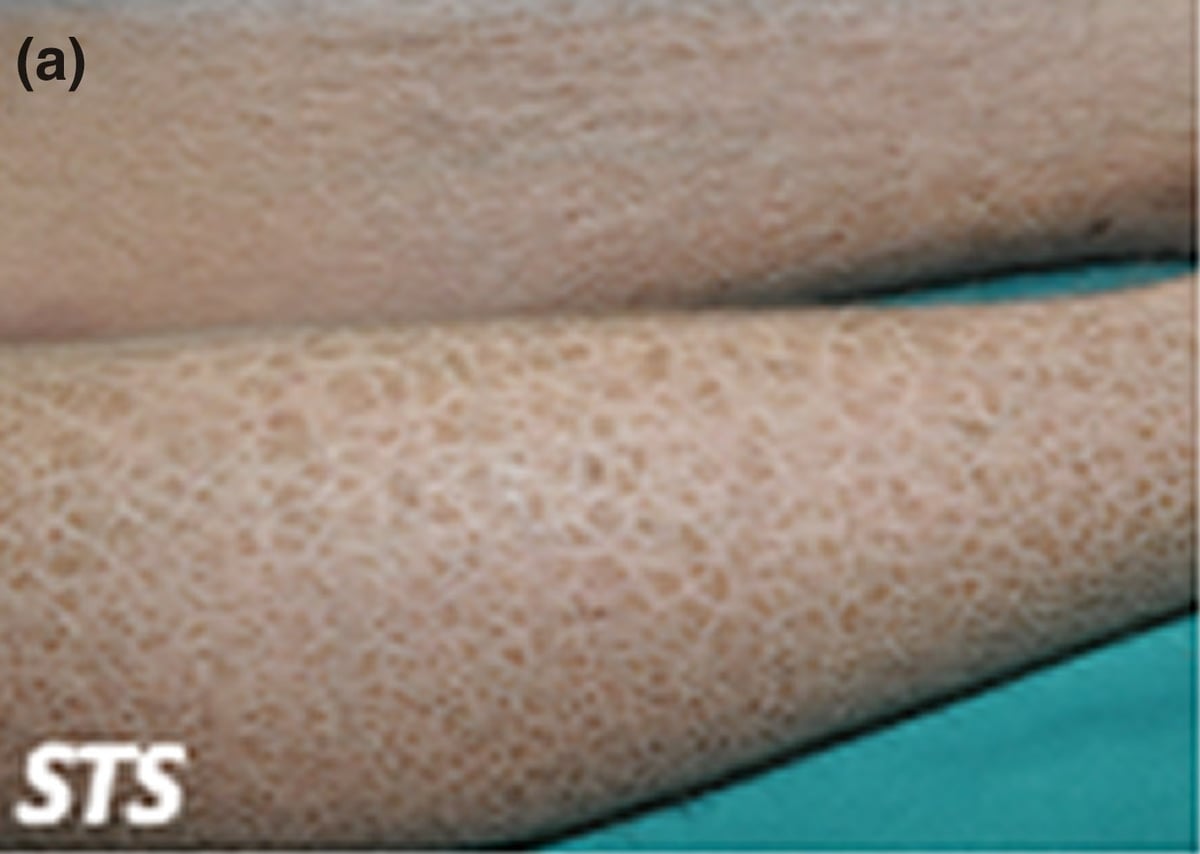
Key Clinical Clues
Generalized medium-large, thick polygonal scales; fine scaling periauricular ('dirty appearance').
Additional Cutaneous Features
Frequently no skin findings at birth. Later: scales are usually dark, but colour is age- and skin colour-dependent; scales improve in the summer.
Additional Extracutaneous Features
Asymptomatic corneal opacities (in adults), cryptorchidism. Can be associated with attention-deficit hyperactivity disorder (in affected individuals and carriers). Can be associated with heart rhythm abnormalities (atrial fibrillation/flutter).
References
Rodrigo-Nicolás B, Bueno-Martinez E, Martin-Santiago A et al. Evidence of the high prevalence of neurological disorders in nonsyndromic X-linked recessive ichthyosis: a retrospective case series. Br J Dermatol 2018; 179:933-9. || Brcic L, Underwood JF, Kendall KM et al. Medical and neurobehavioural phenotypes in carriers of X-linked ichthyosis-associated genetic deletions in the UK Biobank. J Med Genet 2020; 57:692-8.
Summarised from published literature for general information. This is not medical advice, and entries are still being verified. Read the full disclaimer
Clinical Trial Opportunities
This feature is coming soon.