TGM1-nEDD
Previously: Lamellar ichthyosis, CIE, ARCI, self-healing collodion baby, bathing suit ichthyosis
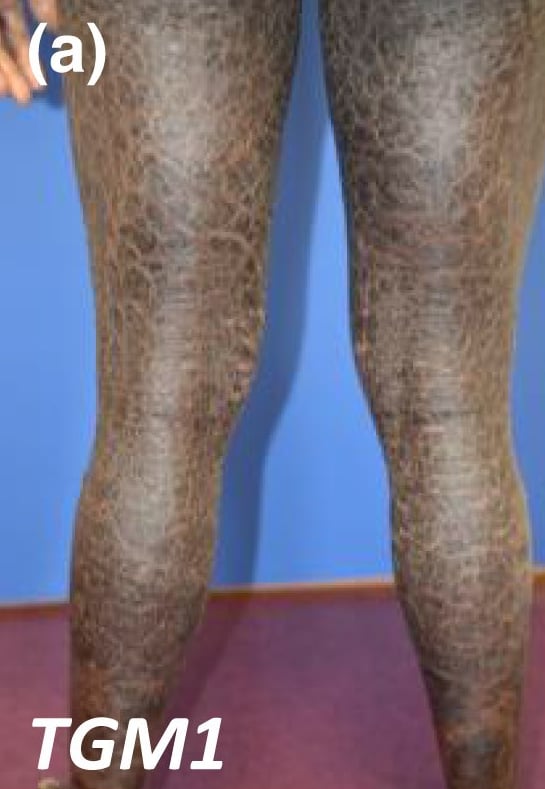
Key Clinical Clues
Collodion presentation, mild fine scaling to severe dark large scaling, variable erythroderma. Can be self-improving or temperature-sensitive (bathing suit pattern). Ectropion and/or alopecia can be present.
Additional Cutaneous Features
Self-improving or self-healing forms sometimes limited to acral areas. Ectropium and eclabium are common. Histopathology (Ultrastructural): malformation of cornified cell envelope and cholesterol clefts within the stratum corneum.
Treatment
Topical application of HSV type 1 vector encoding TGM1 (Freedman, 2021).
References
Huber M, Rettler I, Bernasconi K et al. Mutations of keratinocyte transglutaminase in lamellar ichthyosis. Science 1995; 267:525-8. || Russell LJ, DiGiovanna JJ, Rogers GR et al. Mutations in the gene for transglutaminase 1 in autosomal recessive lamellar ichthyosis. Nat Genet 1995; 9:279-83. || Raghunath M, Hennies H-C, Ahvazi B et al. Self-healing collodion baby: a dynamic phenotype explained by a particular transglutaminase-1 mutation. J Invest Dermatol 2003; 120:224-8. || Oji V, Hautier JM, Ahvazi B et al. Bathing suit ichthyosis is caused by transglutaminase-1 deficiency: evidence for a temperature-sensitive phenotype. Hum Mol Genet 2006; 15:3083-97. || Mazereeuw-Hautier J, Aufenvenne K, Deraison C et al. Acral self-healing collodion baby: report of a new clinical phenotype caused by a novel TGM1 mutation. Br J Dermatol 2009; 161:456-63.
Summarised from published literature for general information. This is not medical advice, and entries are still being verified. Read the full disclaimer
Clinical Trial Opportunities
This feature is coming soon.